
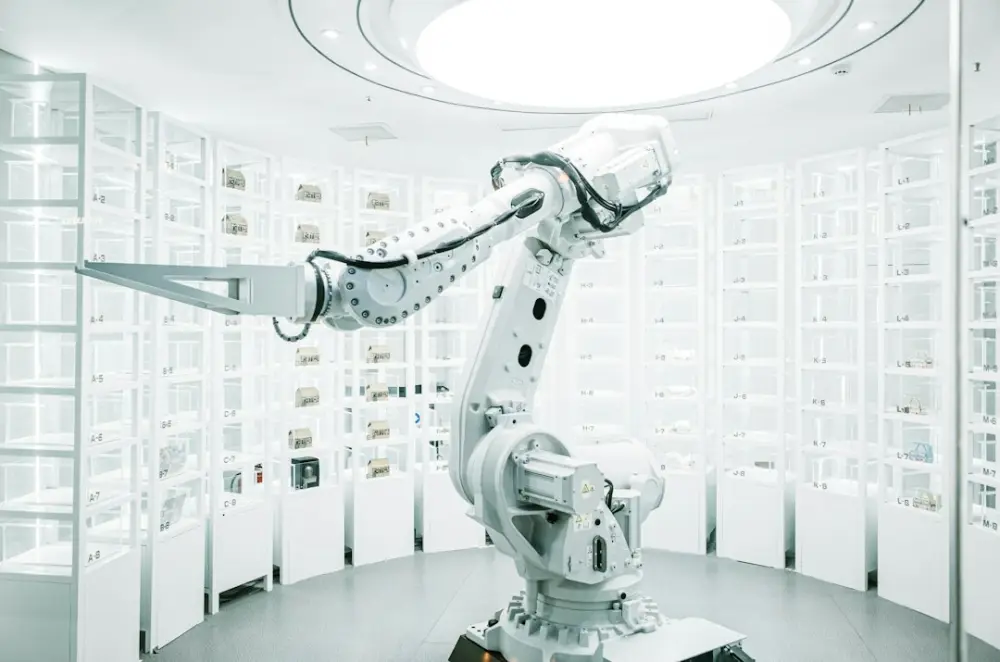
ROS 2 development is the process of engineering modular software for autonomous machines using a decentralized, DDS-based framework. It allows developers to organize complex robotic behaviors into isolated nodes that communicate through standardized topics and services. This approach provides the hardware abstraction and package management necessary for scaling intelligent automation from simple prototypes to complex industrial deployments.
Distributed ROS 2 stacks need tuned QoS and container layout so sensor processing and motor commands stay in sync. Millisecond drift can break safety on autonomous rigs, so treat timing as a design constraint—not an afterthought.
Building Modular Foundations with Nodes and Topics
The fundamental building block of any ROS 2 system is the node. A node is a process that performs a specific computation. For example, one node might handle the driver for a SICK or Velodyne LiDAR sensor, while another node processes that raw point cloud data into a simplified map. By isolating these functions, a failure in the camera driver node does not necessarily crash the entire navigation stack.
Nodes communicate through topics using a bus system. A sensor node "publishes" data to a topic (e.g., /scan), and any node interested in that data "subscribes" to it. This many-to-many communication is handled by the DDS layer, which manages the complexity of discovery and data transport. In a warehouse setting, a fleet of mobile robots might use these topics to share their positions, ensuring they don't collide in narrow aisles.
To keep code manageable, ROS 2 uses packages. A package is the most atomic unit of software you can build and distribute. When planning a robotics pilot on the factory floor, developers often group related nodes, configuration files, and custom message definitions into a single package. This structure makes it easy to share specific functionalities, like a custom gripper controller, across multiple different robot models.
Optimizing Hardware Integration and micro-ROS
Modern ROS 2 development has moved closer to the silicon. While earlier iterations often required a full Linux distribution to run effectively, ROS 2 supports micro-ROS, which brings the framework to microcontrollers like the ESP32 or STM32 series. This allows for a unified communication language from the high-level AI running on an NVIDIA Jetson down to the low-level real-time tasks on an ARM Cortex-M core.
Integrating directly into hardware involves using a Hardware Abstraction Layer (HAL). For instance, if you are building an autonomous delivery rover, you might use a micro-ROS node to read encoder data and control motor PWM signals. This node communicates with the main navigation computer via a serial or Ethernet bridge. Because ROS 2 uses DDS, you can define Quality of Service (QoS) profiles to prioritize critical data, such as emergency stop commands, over less urgent diagnostic telemetry.
This hardware-level integration is a key factor when evaluating the top 7 real-world use cases of smart robotics. Whether it is precision agriculture or automated surgical assistants, the ability to maintain low-latency communication between high-level logic and physical actuators is what makes these systems reliable in 2026.
Managing Process Layouts for High-Bandwidth Sensors
A common challenge in robotics is the overhead of inter-process communication. In a standard setup, sending a high-resolution image from a camera node to a vision processing node involves copying data across the memory space, which consumes CPU cycles. ROS 2 addresses this through component containers and intra-process communication.
By using component containers, developers can delay the decision on process layout until deployment time. Multiple nodes can be loaded into a single process container, allowing them to share memory pointers instead of copying data. This "zero-copy" transport is vital for high-bandwidth sensors like 4K cameras or high-frequency IMUs. In a 2026 production environment, this means a robot can process more data per second without needing more expensive, power-hungry compute hardware.
Deployment management also involves the use of Colcon, the standard build tool for ROS 2. Colcon automates the building and testing of multiple packages in the correct order. For a team deploying a fleet of autonomous drones, Colcon ensures that the custom communication protocols are built before the flight control software that depends on them, reducing the risk of version mismatches in the field.
Reliability through Deterministic Launch and Introspection
Launching a complex robot involves starting dozens of nodes in a specific sequence. ROS 2 uses Python-based launch files to manage this orchestration. Unlike simple shell scripts, these launch files can include logic to monitor node health, restart crashed processes, or change parameters based on the environment. For example, a robot might load a different set of sensor configurations depending on whether it detects it is indoors or outdoors.
Once the system is running, introspection tools are used to verify performance. RViz2 provides a 3D visualization of the robot’s world, showing sensor data, planned paths, and coordinate transforms (TF). If a robot is struggling to localize itself in a new hospital wing, a developer can use ros2 topic echo to inspect live data streams or ros2 bag to record the sensor data for offline playback and debugging. This ability to record and replay data is essential for identifying edge cases that only occur after hours of operation.
System monitoring also extends to the Lifecycle Node concept. This allows a central manager to transition nodes through states like "unconfigured," "inactive," and "active." This level of control ensures that a robot doesn't start moving until its safety sensors are confirmed to be in an active, healthy state, providing a layer of deterministic behavior required for industrial safety standards.
Developing Custom C++ and Python ROS 2 Packages
C++ packages: run ros2 pkg create my_cpp_pkg --build-type ament_cmake, add dependencies in package.xml, place nodes under src/, and build with colcon build. Launch files live in launch/ once interfaces are generated.
Python packages: use ros2 pkg create my_py_pkg --build-type ament_python, declare entry points in setup.py, and install nodes under my_py_pkg/. Test with ros2 run my_py_pkg talker before wiring multi-node graphs.
Push nodes to hardware only after deterministic launch order is documented—start bring-up scripts, then perception, then motion—to keep deploy-time layout decisions explicit.
Roadmap for Starting an Autonomous ROS 2 Project
To begin developing a robust software stack, you must establish a workflow that prioritizes deterministic communication and modularity.
- Start by selecting a Long Term Support (LTS) distribution like ROS 2 Humble or Jazzy to ensure your system benefits from multi-year security patches and stability.
- The first step in defining your system architecture is to create custom message definitions (.msg) that standardize how your specific sensors and actuators exchange data.
- Next, configure your DDS middleware settings to prioritize mission-critical topics, such as emergency stops and localization data, over high-bandwidth diagnostic streams.
- Proceed by containerizing your nodes to allow for zero-copy data transfer, which is essential for processing high-frequency LiDAR or camera inputs without CPU bottlenecks.
- Finally, develop a centralized launch sequence that uses lifecycle nodes to verify that all safety systems are active before the robot transitions to its operational state.
Scaling Intelligent Automation with Arimaz
Building for autonomy requires more than just code; it requires a strategy for scaling and reliability. As we navigate the technical requirements of 2026, the focus shifts from making a robot move to making a fleet of robots perform consistently across diverse environments. ROS 2 provides the architectural backbone, but the implementation requires a deep understanding of how software interacts with physical constraints.
At ArimaZ, the focus is on bridging the gap between framework potential and real-world impact. By utilizing modular ROS 2 architectures, it becomes possible to iterate on specific robotic behaviors without rebuilding the entire system. This approach speeds up the development cycle and ensures that autonomous systems remain adaptable. Whether the goal is optimizing logistics or enhancing precision in manufacturing, ArimaZ provides the expertise needed to turn intelligent automation into a practical, scalable reality.